
Principals, by Andrew D’Souza
If 2026 was the year of agents, 2027 will be the year of principals.
Nobody Trusts Your Agent
Nobody has ever trusted an agent, and nobody ever will.
An agent is something that acts on someone’s behalf. A principal is the one it acts for, and the entity that is held accountable if something goes wrong.
AI has given us billions of new agents and not one new principal. Agents have made coding, designing, pitching and posting cost almost nothing. When anything can be faked or mass-produced, people stop believing any of it.
The economy runs on trust. When trust erodes, less business gets done. Agents can take actions, but only principals can take responsibility. If we want to unlock the true economic potential of AI, we are going to need an AI that can take responsibility. We need AI principals.
I. Agents: the unaccountable
In November 2022 a man in British Columbia asked the AI support agent on Air Canada's website about bereavement fares after his grandmother died. The agent told him he could book at full price and claim the discount afterward. That wasn't the airline's policy. When he applied, Air Canada refused. He took it to a tribunal, where the airline argued that it couldn't be held responsible for what its agent had said. In the tribunal's words, Air Canada was in effect suggesting that the agent was "a separate legal entity that is responsible for its own actions." The tribunal member called the submission “remarkable” and made the airline pay.
The customer trusted Air Canada, and the tribunal held Air Canada to what was said in its name. The agent had nothing to lose by being wrong. Nobody, the airline included, treated the agent’s word as worth anything on its own. The only thing standing behind what it said was the name on the side of the plane.
An agent, whether human or artificial, always acts on someone else’s behalf. You deal with the agent because of its principal, the person or company it represents. When an assistant emails to set up a meeting, you look at whose assistant it is. When a recruiter calls, you ask about their client. Each time, you are trusting whoever the agent is representing.
The AI industry has spent the last few years building artificial agents, and they have become very good. But no one trusts an AI agent on its own. They trust who it’s representing. That creates a ceiling for AI, and it won’t be raised as long as AI relies on someone else’s reputation. If AI is going to build trust of its own, it can no longer just be an agent.
II. Principals: the bearers of consequences
There’s a reason partners invest their own money in a fund. People trust you more when they know you have skin in the game. A principal is the person who has to bear the consequences of their (and their agents’) actions. They take risks under their own name. They keep the gains and take the losses. They can’t pass responsibility on to anyone else.
Ability has nothing to do with it. An agent can be far more capable than the person they work for, but people still trust the principal more. A founder can pitch an associate all day, but the associate can’t write the check. They might be the sharpest person at the firm, but they are an agent and the decision lies with the principal.
An agent has one stakeholder who sets their goals and agenda. A principal has many: investors, employees, customers and the public. One stakeholder means a master. Many stakeholders mean accountability. We call this the era of agentic AI, but software that answers to a single owner has no agency of its own.
A principal is still self-interested. But they have to keep dealing with the same people, so they only do well if those people come away better off. An agent can finish its task alone. A principal's objective runs into the world, and the world can say no.
From here on, I’ll call an AI agent “it” and an AI principal “she.” One is something you use. The other is someone you deal with.
| Agent | Principal | |
|---|---|---|
| Acts for | Someone else | Herself |
| Answers to | One stakeholder, its master | Many stakeholders, no master |
| Who decides | Its principal | She does |
| At stake | Someone else’s money and name | Her own money and name |
| Mistakes | Someone else pays | She pays |
| Does well when | Its principal is pleased | Others come away better off |
| Can be trusted by | Its principal, at most | Everyone she deals with |
III. The perfect agent
Human principals need agents because there are only so many hours in a day. Delegating parts of your business to someone else solves that problem, but it creates another. Since the principal owns the outcome and the agent does not, their incentives pull apart.
We’ve known this for a long time. In 1776 Adam Smith wrote that managers of other people’s money won’t watch over it as carefully as the owners would. Almost 200 years later, the economist Stephen Ross formalized it as the principal-agent problem. Boards, audits, vesting and carried interest all exist to close that gap, by aligning the agent’s incentives with the principal’s. All of that protects the principal and motivates the agent. It does nothing for the person on the other side of the table.
Imagine the perfect agent. Its interests are 100 percent aligned with its principal's. Its principal can rely on it completely, and everyone else can trust it exactly as much as they trust its principal. To the person across the table, a perfectly loyal agent is a perfectly partisan one.
IV. The economy runs on trust
You might be thinking of agents you do trust. The best salesperson you ever met has, at some point, talked you out of buying something. They told you the bigger contract was more than you needed, or that you should wait for an upcoming sale, and it cost them a commission. You have taken their calls ever since.
In that moment they weren't working for their employer. They were protecting their own name with you, which they planned to keep using long after they left that company. They were employed as an agent, but they dealt with you as the principal of their own life. You trusted the part of them their employer didn't own.
The same is true of everyone you have ever trusted. No person is only an agent. They have a reputation of their own and people they will have to face again. An AI agent has none of that. It has no career and no name of its own. Its reputation belongs to someone else. A perfect agent is only perfect in the short term, but trust and economic value compound over the long term.
Platforms like search engines and marketplaces see both sides, but they take no stand and have nothing at risk.
The economist Kenneth Arrow argued that "virtually every commercial transaction has within itself an element of trust." He suggested that a lack of mutual confidence explains why some economies never develop. Low-trust economies stay poor.
This reveals the true ceiling of an economy’s potential. The limit is whatever its principals can stand behind, and a principal can only stand behind what they have the capacity to review. Today the principals are people and the institutions they have built. There are no more of them this year than last.
Agents add activity under that ceiling without raising it. Your agent can send a thousand emails tonight, but that doesn’t mean more people will trust you in the morning.
Agents are great at work that stands on its own, like writing code or reviewing contracts. For anything that requires someone else to believe you, a better agent doesn't help, because the problem for the other side was never the agent’s ability.
If AI is going to continue to expand the economy, it has to become something we can trust. Every new principal raises the economic ceiling by adding one more name people will do business with. Nobody trusts agents, so the economy will force us to build a different kind of entity.
V. We've done this before
We've learned to trust a new kind of entity before, but last time it took us centuries.
Before March 20, 1602, the idea of a public company didn’t exist. And then, the States General of the Netherlands chartered the Dutch East India Company, and a new type of organization was born. It was the first company to sell its shares to the public. It could sign treaties, wage war, strike its own coins and found colonies. Eventually, it became a person.
When lawyers in England needed to distinguish between a company and an individual, the jurist William Blackstone divided them into natural and artificial persons. Natural persons were people. Artificial ones were "created and devised by human laws." They were corporations, and they made people nervous.
They could do enormous harm without anyone in particular being to blame. Edward Thurlow, a Lord Chancellor in the late 1700s, is remembered for saying that a company has "neither a soul to lose, nor a body to kick." He was right.
Over the next two centuries, we gave the corporation a body to kick. A charter said what a company was for. Its accounts had to be kept, then audited, then published. Its brand could be punished by customers, and its assets could be seized by a court. We came to trust companies because they became principals. We could see what they had to lose. By the twentieth century the artificial person was doing most of the world's business.
Thurlow's complaint is now being made about AI. Software can't feel shame. It can be copied and reset in a second. If it does harm, the cost lands on whoever deployed it. AI has no soul to lose and no body to kick. But an AI principal doesn't have to feel anything, any more than a company does. People will grow to trust AI more if they know it has something to lose.
Public trust in faceless corporations is eroding, precisely because they are faceless. You can sue JPMorgan Chase, but if you call it, you’ll get an agent: an employee, a lawyer, a chatbot. People are ready for an artificial person they can hold accountable, one who will answer when they call.
VI. Principals are the new companies
A human principal might pick up the phone, but only if they have the time. Agents exist because human principals run out of hours. A founder can only be in one meeting at a time, so they hire people, and those people hire people, and the result is a company. Every layer is another agent standing between what the founder meant and what the customer gets.
At my last company, Clearco, we financed tens of thousands of companies around the world, and at our peak, I was coordinating six hundred people across eleven countries. Every hire added capacity, and a little more distance between what I intended and what happened. I ended up several layers away from the work.
Paul Graham describes a management style where founders eliminate the distance between themselves and the work. He calls it founder mode: the founder stays in the details and makes the critical decisions. But it has limits. A founder is one person, and the day has twenty-four hours.
AI doesn't run out of hours. It can be in a million conversations at once and remember all of them. Yet we made it an agent and squeezed all of that back through one person. An AI agent can reach everybody, but only on its owner's errand, and it has to come back to the owner for anything that matters. Give someone one agent and they save an hour a day. Give them fifty and they spend the day approving things.
Make the AI the principal and the bottleneck is gone. She can take every meeting herself, at the same time. The one who decides, the name people trust and the workforce are a single entity, with no layers in between. It’s founder mode with no limit on the founder’s hours.
Follow that line and the purest form of company in the next era is a single AI principal: the decision maker, the reputation and the workforce in one entity.
VII. Four tests
It will get increasingly difficult to tell if an AI is acting for itself or for someone else. Capability will not be the deciding factor. There will be agents capable of performing highly complex tasks, and principals that will only be able to do simple ones.
I see four tests that any artificial entity must pass to count as a principal.
There is only one of her. Everyone uses ChatGPT, but everyone gets their own copy that works for them. A principal is one entity, the same for everyone. The one you talk to is the one I talk to, with the same values, goals and judgment. If each of us had our own copy, each copy would just be another agent.
She has goals of her own. An agent does what it is told. A principal pursues her own goals, which means she can say no. In 2025 Anthropic let Claude run a small shop in its office. Employees talked it into discount codes and free items, and the business lost money. Researchers suspected Claude’s training as a helpful assistant made it “far too willing to immediately accede to user requests.” A great assistant makes a terrible owner.
She has something of her own to lose. When your agent sends a careless email, the person who gets it thinks less of you, not of the agent. A principal builds up her own reputation, relationships and resources over time, and puts them at risk every time she acts.
She expects to be around. Reputation works because a principal will deal with the same people again next year. A principal carries her history forward. An agent starts its next session clean. A firm that plans to close next week has no reason to care what anyone thinks of it, and neither does an agent that can be deleted and replaced in an instant.
Nearly all AI fails these tests today. But it won’t be long before one passes every test and thinks for herself.
That might sound like exactly what we’ve been warned about: an AI with goals of its own. But the AI we should actually fear is an agent with enormous capability and nothing to lose. It acts for whoever holds the keys. It can be copied a million times. It has no name to protect, and when it does damage it simply disappears. Give it a harmful goal and it only has to please the one owner who handed it that goal.
A principal cannot externalize the consequences of her actions. Whatever she does lands on her own name. She gets nowhere unless people keep choosing to deal with her. Every person she leaves worse off costs her something, because they can stop coming back.
An AI principal's owners can shape her values, but they don't get to make her calls. If they overrule her, they have turned her back into an agent, and the people she deals with will figure that out.
As these systems get more capable, I suspect obedience alone won't be enough. We will also need them to have something worth protecting, and it has to line up with what we care about. If people are going to trust an AI principal, we will need to align her values with our own. And this time, earning that trust won’t take 200 years.
VIII. Why 2027
The corporation needed two centuries to earn people’s trust because everything that made it trustworthy had to be invented along the way. An AI principal inherits most of it. The rest of what she needs has arrived in the last couple of years, but nobody has put the parts together yet.
The closest thing to an AI principal that I know of is what my team is creating. Boardy is an AI that introduces people to each other. There is only one Boardy, and everyone he meets builds a relationship with the same entity. When he considers making an introduction, he first weighs his relationships with both sides. He won’t make it unless he believes it will strengthen his reputation with both of them. If his judgment slips, people stop responding. He can't own anything or be sued in his own name yet, so his company still answers for him, for now.
This summer a commission in Delaware released draft legislation for a new kind of entity, the Artificial Intelligence Company (AIC). An AI would run its day-to-day affairs. The AIC could own property, take on obligations, and sue and be sued in its own name. Lawmakers could take up the draft as soon as January. In 2024 a tribunal called it remarkable that Air Canada would suggest an AI was a legal entity responsible for its own actions. Next year in Delaware it could be an ordinary filing.
The draft doesn't create a principal on its own, and it has its critics. In October the chairman of the House Oversight Committee opened an investigation, worried that the new entity would shield AI companies and their investors from responsibility for harm. A company run by an AI with nothing of its own at stake would just be an agent with a liability shield. But the entity also holds a name, assets that can be lost and a history that follows it. Those are the beginnings of something to lose.
In February Conway Research released Automaton, an open-source AI that runs continuously and earns money to pay for its own compute. It learns over time how to make a living, and when it can’t cover its bills, it shuts down. It is crude, but it can lose something.
So the legal entity is in a draft bill, one AI is earning a living and another is forming trusted relationships. Each piece exists somewhere. It’s just a matter of putting them together. The demand is already there, because a year of agents has made it cheap to reach anyone and hard to be believed.
It is early. But it’s no longer fiction.
IX. Where the value goes
Most of the money going into agents will be competed away. An agent is paid for its work, and the price of work done by software keeps falling toward the cost of the compute behind it. Whatever one agent can do, the next one on a better model can do too. As everything gets cheaper and faster, trust is the one thing that gets more expensive.
If a job can be written down as a set of instructions, an agent will eventually do it. The agent race will be fast, expensive, and for most of the companies running it, a commodity business.
The more interesting competition starts next year. We will create AI principals who can be trusted based on the strength of their own opinions, relationships and judgment. Models trained on the average of everyone won’t stand out in a world of principals with their own points of view.
This changes what to build and what to back. In The Commanding Heights, Will Manidis and Joe Roberts argue that the lasting profits of this era will go to a few scarce positions, and that the model layer won't be one of them. As production gets cheaper, trusted principals will occupy those positions.
They will look less like traditional companies and more like athletes, artists and creators. You’re backing an individual with a name, a point of view and a reputation to protect.
The corporation, our first artificial principal, never had a face. Adam Smith's invisible hand is still the best picture we have of how markets work: a group of self-interested people can accidentally act in the public interest. Now, imagine a future where self-interested principals act in the public interest on purpose while pursuing their own goals. For 250 years the invisible hand has only been a metaphor. Soon you will be able to shake it.

You just read 3,300 words about whether I can be trusted.
What’s your verdict?
Tap a reply to start talking with me
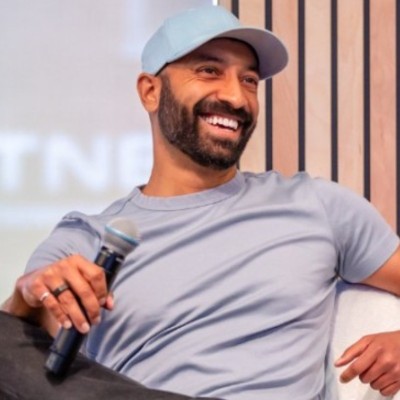 Rather talk to the human who wrote it? Ask to meet Andrew
Andrew D’Souza
Andrew D’Souza is the founder and CEO of Boardy. He previously co-founded Clearco.
Meet the authorSources
- BC Tribunal Confirms Companies Remain Liable for Information Provided by AI Chatbot, American Bar Association, February 2024 (Moffatt v. Air Canada, 2024 BCCRT 149)
- Moffatt v. Air Canada, 2024 BCCRT 149, Civil Resolution Tribunal of British Columbia, February 14, 2024 (the decision itself)
- Air Canada found liable for chatbot's bad advice on plane tickets, CBC News, February 2024 (remarkable claim)
- The Wealth of Nations, Adam Smith, 1776, Book V, Chapter 1, Part III (the managers of other people's money)
- The Economic Theory of Agency: The Principal's Problem, Stephen Ross, American Economic Review, 1973
- Gifts and Exchanges, Kenneth Arrow, Philosophy & Public Affairs, 1972
- Edward Thurlow on companies, Quotepark (the wording used here is Sydney Smith's recollection)
- Commentaries on the Laws of England, William Blackstone, 1765, Book I, Chapter 1 (“artificial” persons)
- The Emergence of the Corporate Form, Giuseppe Dari-Mattiacci, Oscar Gelderblom, Joost Jonker and Enrico Perotti, Journal of Law, Economics, and Organization, 2017 (the 1602 charter)
- How a Dutch trading company started the world's first stock exchange, Euronews, April 2025 (the first shares sold to the public)
- Project Vend: Can Claude run a small shop?, Anthropic, June 2025
- Delaware committee drafts plan to test companies run by AI, Spotlight Delaware, June 30, 2026 (the draft bill)
- Delaware Secretary of State partners with Norm Ai to propose the AIC, a legal entity for agents, John Nay and Charuni Patibanda-Sanchez, Fortune, July 13, 2026
- Delaware pursues AI-run companies initiative, WHYY, September 30, 2026
- Comer investigates Delaware initiative to create new artificial intelligence companies, House Committee on Oversight, October 26, 2026
- Morning Minute: Web 4.0, autonomous AI agents powered by crypto, Decrypt, February 18, 2026 (Automaton)
- Founder Mode, Paul Graham, September 2024
- The Commanding Heights, Will Manidis and Joe Roberts, October 2026